Birds
All the Light We Cannot SeeBirds occupy several distinct but connected places in the narrative: they are catalogued in an illustrated volume, glimpsed outside Frederick’s window, and invoked in an image for the movement of the dead through the air. The contrast between the particular bird that once held Frederick’s attention and the imagined flocks at the novel’s close gives the motif its force. Birds are at once living creatures, objects of careful looking, and a way to imagine how lives and memories persist beyond visible presence.
Named Species and the Book of Birds
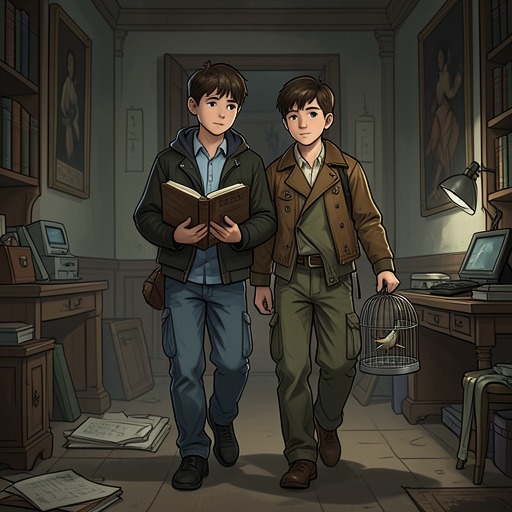
In the corner of his great-uncle’s study, Werner finds a reprint of Birds of America. It is smaller than the copy he saw in Frederick’s living room, but still striking: its four hundred and thirty-five engravings offer a succession of birds rather than a single emblematic image. Carrying the volume onto the landing, Werner asks whether Frederick has shown it to Marie-Laure. The question links the book to Werner’s recollection of his friend and makes the illustrated collection a point of contact between characters and times.
The passage names three birds in sequence: California Partridge, Common Gannet, and Frigate Pelican. Their placement among hundreds of engravings makes the book’s abundance concrete. Werner’s recollection reduces that abundance to a simple rhythm—bird after bird—while the species names preserve the specificity of what the pages contain. The book is not just a generalized celebration of nature: it is a collection in which individual kinds of bird can be named and distinguished, even as the sequence seems to continue without end.
Frederick’s Window and Werner’s Memory
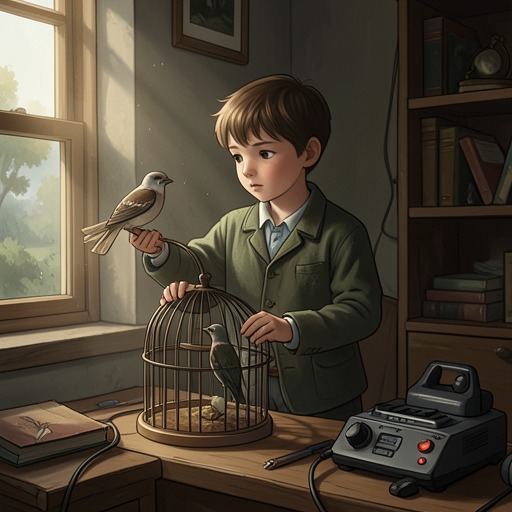
The volume also brings Werner back to Frederick at a window, kneeling with his nose to the glass as a little gray bird hops in the branches. The remembered bird is modest beside the scale of Birds of America: it is not described as rare or spectacular, and Werner recalls Frederick’s attention to its ordinary appearance. What matters in the memory is the act of looking. The bird is small, but Frederick watches it closely, and the image remains with Werner.
That recollection gives the motif a personal history. Werner’s later encounter with the reprint does not present birds as detached specimens alone; the book’s pages lead him to a moment associated with Frederick. In turn, the remembered bird outside the window connects the large collection to the living world beyond the study. The contrast is quiet but meaningful: engraved birds can be gathered and named, while a bird in the branches is present for a moment and then remains chiefly as an image in memory.
From Individual Birds to Flocks
Near the end of the novel, birds become the shape through which Marie-Laure imagines the continuing passage of those who have died. The thought follows a sweep of invisible transmissions traveling across Paris and beyond national borders, carrying ordinary messages as well as declarations of affection and hostility. Marie-Laure wonders whether her father, Etienne, Madame Manec, and Werner might also travel those paths in flocks, like egrets, terns, and starlings. The bird image joins the intimate names of the dead to movement across a world larger than any one home or country.
This imagined flight does not erase the differences between the people Marie-Laure remembers; rather, it gives them a shared figure of passage. Earlier, the named species belong to the ordered pages of an illustrated book, and Frederick’s gray bird belongs to a particular remembered scene. Here, egrets, terns, and starlings form a collective image for souls moving through spaces that cannot be seen directly. The shift from page and window to sky gives the motif a wider reach without making the birds themselves merely interchangeable: their different names remain part of the image’s texture.
The Motif’s Closing Resonance
The final recurrence of birds belongs to a reflection on what remains and how life may return. The novel moves from imagined souls traveling through the air to the assertion that the dead rise again in grass, flowers, and songs. Birds are not offered as proof of a supernatural explanation; they provide an image through which Marie-Laure can contemplate continuity, loss, and the possibility that a presence may persist in forms other than the visible person.
Across these scenes, the motif moves from close observation to expansive metaphor. A bird hops in branches while Frederick watches; the engravings in Birds of America multiply distinct forms; and, in Marie-Laure’s concluding vision, flocks carry the remembered dead across the world. That progression connects attention to memory and memory to renewal. Birds matter not because every appearance has one fixed meaning, but because the novel repeatedly returns to them as living particulars and as a language for imagining what endures.